
Jul 4, 8:01 PM
Celluloid and Capitalism: How Karlovy Vary Defies the European Festival Formula
The Czech film festival is celebrating its 60th edition, relying on private sponsors rather than state bureaucracy to draw Hollywood stars and backpackers alike.
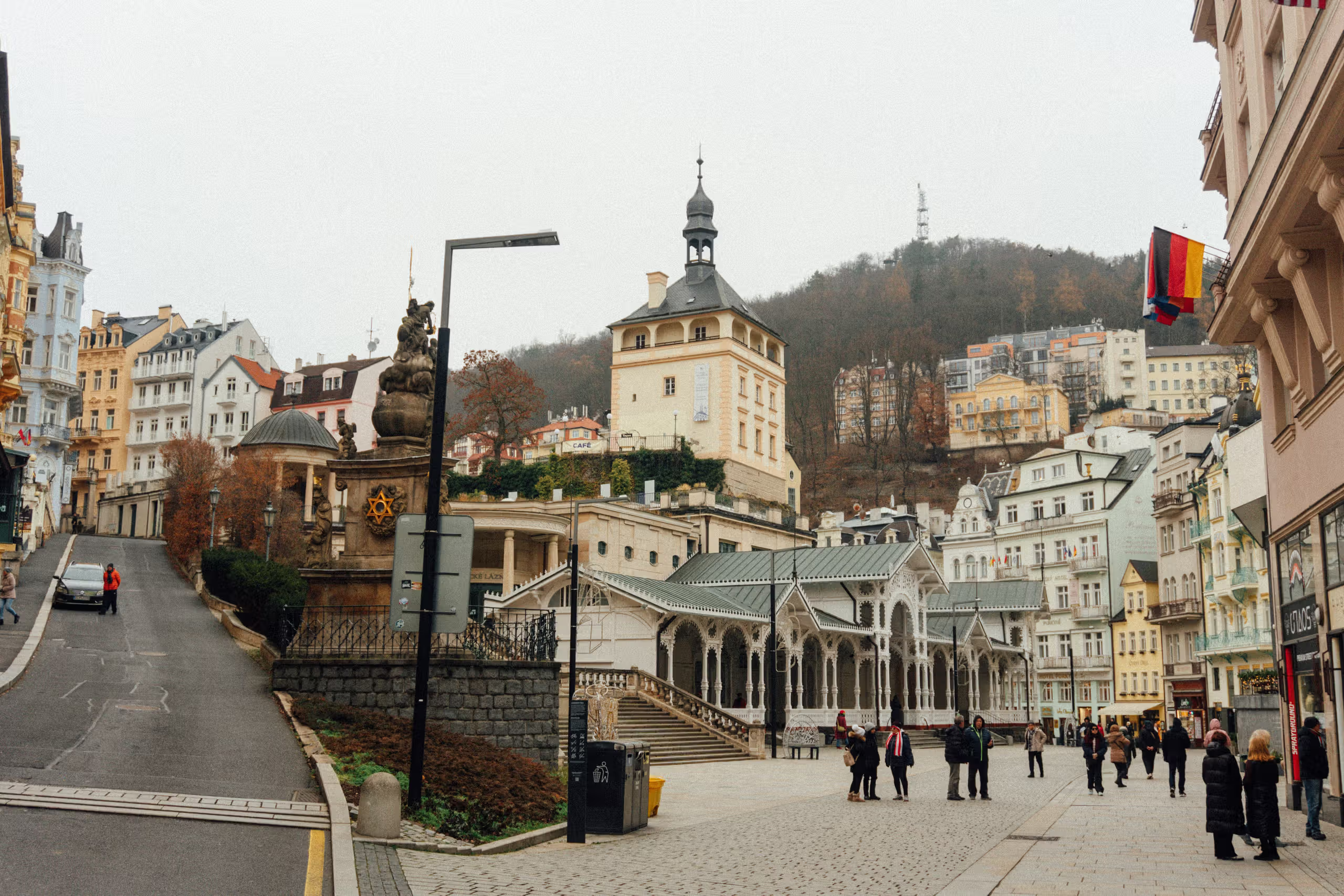
The red carpets of Europe’s premier film festivals usually share two distinct characteristics: an abundance of haute couture and an overwhelming reliance on the taxpayer. The Karlovy Vary International Film Festival, currently celebrating its sixtieth edition in the picturesque Czech spa town, gleefully dispenses with the latter. While Hollywood veterans like Dustin Hoffman, Harvey Keitel, and Maggie Gyllenhaal stroll through the Bohemian architecture, the festival’s operational engine provides a stark lesson in cultural economics.
Founded in 1946, Karlovy Vary is the world’s second-oldest film gathering, predated only by Venice. Yet its history vividly illustrates the suffocating nature of state control. For decades, Soviet cultural commissars forced the event to alternate annually with Moscow, reducing a proud cinematic tradition to a mere geopolitical pawn. It survived communist normalization and the 1968 occupation, only to face near-extinction in the 1990s when post-revolution funding dried up and a rival Prague festival threatened its monopoly.
Salvation arrived not from a government committee or a sprawling Brussels cultural fund, but through private enterprise. The late actor Jiří Bartoška, alongside film historian Eva Zaoralová, dragged the festival into the modern era in 1994. When the culture ministry of the day explicitly refused to provide financial backing, Bartoška personally signed a substantial promissory note to keep the projectors running. He leveraged his connections with figures like Václav Havel and Václav Klaus to attract private capital.
That entrepreneurial gamble permanently altered the festival's DNA. Today, under the stewardship of a triumvirate led by Executive Director Kryštof Mucha, Karlovy Vary operates on a budget of roughly ten million euros. A staggering seventy percent of this capital is sourced from private sponsors, leaving just a fraction to be covered by the state and local municipalities. In a European cultural landscape where institutions routinely lobby for ever-larger public subsidies while delivering increasingly esoteric, audience-alienating content, this funding structure is a glaring anomaly.
Because the festival relies on actual appeal rather than bureaucratic goodwill, it has democratized cinema far more effectively than any state mandate ever could. The two hundred films screened this year are not reserved solely for industry insiders trading business cards. Visitors can purchase tickets for less than three euros. This pricing strategy draws tens of thousands of young cinephiles, many of whom sleep in designated campsites just to attend.
By remaining in a compact spa town—famously described by Le Corbusier as an assembly of Art Nouveau cakes—the event forces attendees to engage with the medium rather than treating it as a convenient distraction in a sprawling metropolis. The festival, which runs until the eleventh of July, demonstrates that when culture is untethered from the stifling embrace of state bureaucracy and forced to justify its existence to the market, it does not perish. It thrives, drawing both Hollywood royalty and backpackers to the same darkened theatres.
Written by Christiane Hofreiter christiane.hofreiter@alpineweekly.com


