
Aug 30, 6:02 AM
The Price of Urban Ground: Where European Capital Actually Flowered in 2026
From Zurich's summit to Brussels' bargain basement, Deutsche Bank's urban index exposes the continent's deep economic fault lines.
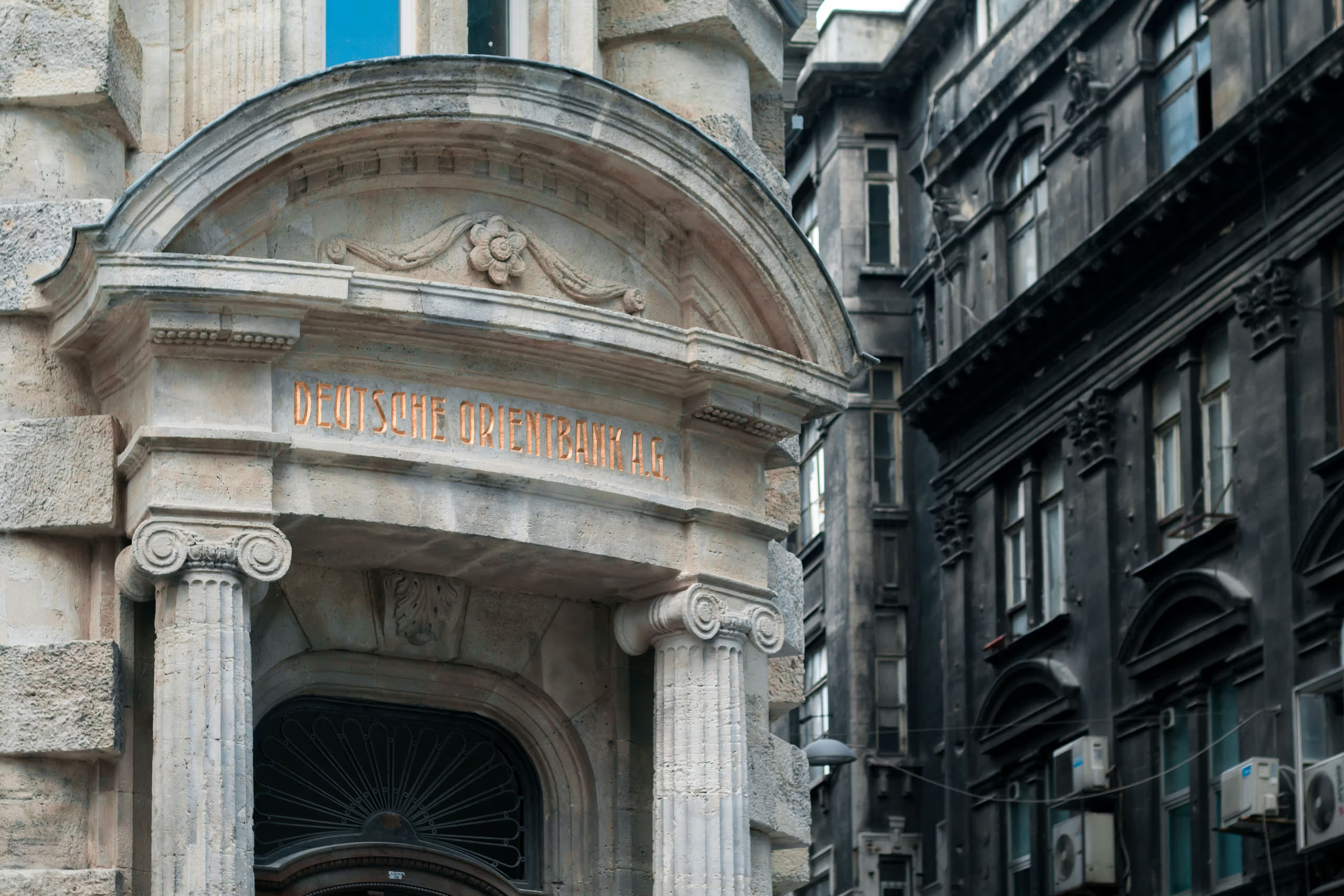
If money talks, real estate screams. The Deutsche Bank Research Institute’s Mapping the World’s Prices 2026 report lays bare the stark geography of European urban capital, where owning a standard eighty-square-metre flat has turned into a luxury reserved for institutional balance sheets and sovereign wealth funds. Drawing on data from Numbeo and European Central Bank exchange rates across twenty-eight European cities, the study paints a ruthless picture of financial concentration. The continental average sits at 9,090 euros per square metre, but aggregate figures conceal far more than they reveal.
At the summit of European exuberance stands non-EU Switzerland, quietly sitting on immense wealth while pricing out virtually everyone else. Zurich leads the continent—and ranks second globally behind only Hong Kong’s 23,790 euros—at a staggering 22,910 euros per square metre. Geneva follows close behind at 19,439 euros. Buying an eighty-square-metre apartment in Zurich now requires roughly 1.83 million euros, a sum that underscores the immense capital accumulation flourishing comfortably outside the European Union’s regulatory orbit.
Across the Channel, London retains its position as an expensive enclave despite broader British headwinds, claiming third place in Europe at 17,241 euros per square metre. That makes central London roughly 35 percent more expensive than Paris, where prime square metres command 12,771 euros. Vienna completes the top five at 12,483 euros, while Germany’s primary wealth engine, Munich, follows at 11,435 euros per square metre. Solid, highly capitalized centers like Luxembourg also maintain elevated valuations at 11,011 euros, proving that private capital still seeks refuge where state finances remain stable.
Yet the true paradoxes lie further down the ranking, where European economic realities produce telling anomalies. Prague, at 8,352 euros per square metre, now commands higher property prices than the political capitals of Western Europe, outstripping Madrid at 7,831 euros and Berlin at 7,613 euros. In Germany's political center, property remains surprisingly cheap compared to its regional peers, lagging behind Frankfurt’s 7,162 euros and reflecting a capital city that produces far more bureaucracy than economic value.
The bottom of the European list is perhaps the most revealing of all. Brussels, the self-important nerve center of European Union governance, ranks among the cheapest urban markets analyzed. Sitting third from the bottom at a mere 4,380 euros per square metre, the EU capital barely edges out troubled markets like Athens at 3,442 euros and Istanbul at 2,646 euros. While civil servants inside the European machinery churn through endless mandates, the surrounding real estate market offers a remarkably sober valuation of the EU capital's actual economic magnetism.
Written by Freya Stensrud freya.stensrud@alpineweekly.com


